
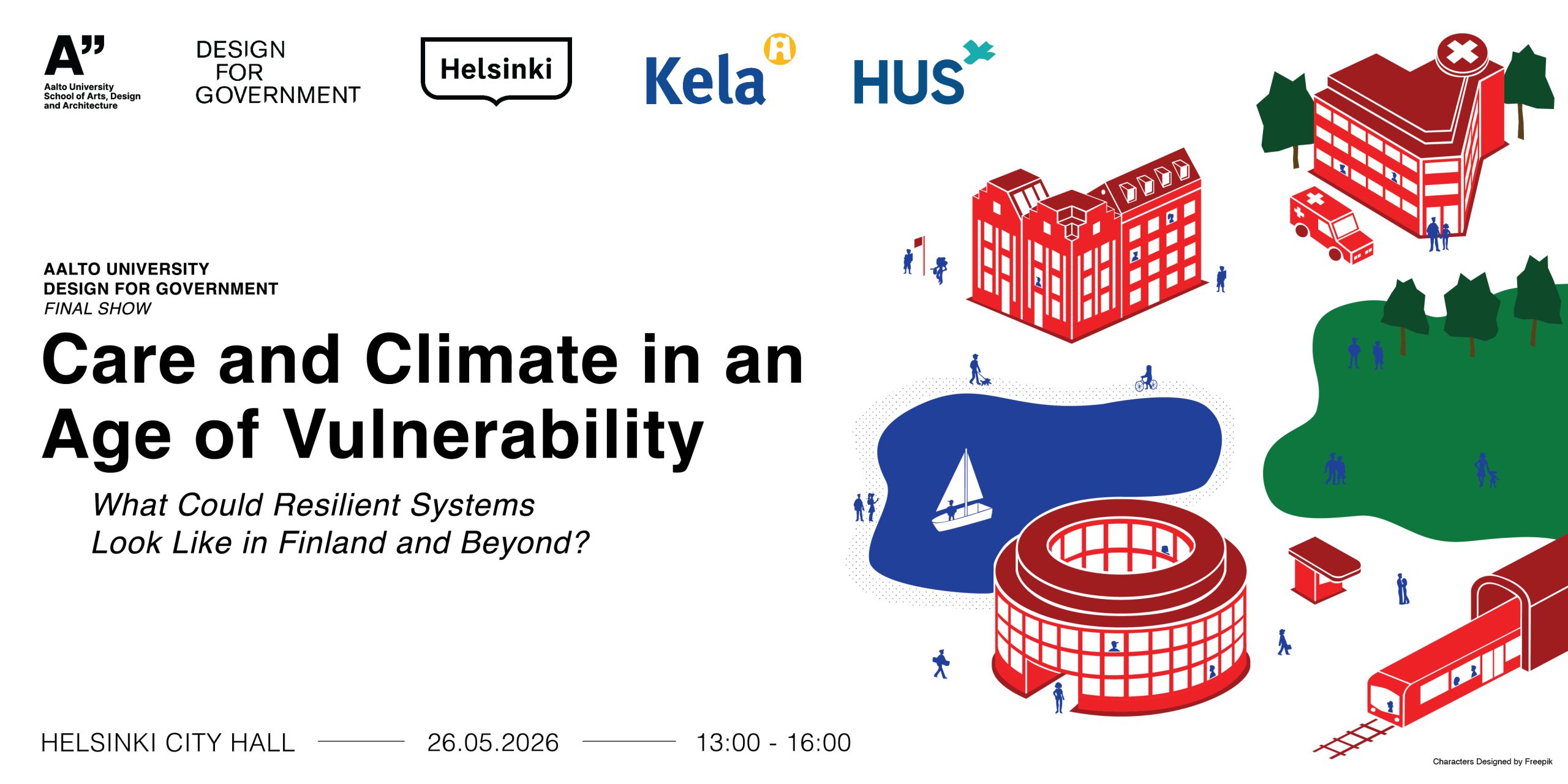
This year, the Final Show will showcase the “Climate Adaptation” work with the City of Helsinki and the “Continuity of Understanding” with Kela and HUS.
Design for Government (DfG) is an Aalto University MA course in which students collaborate with Finnish ministries and public service organisations each year to tackle national-level challenges with a design approach.
After 12 weeks of close collaboration, students from four groups will present their research and design proposals in one event, gathering the community of civil servants, practitioners, and researchers to get inspired in designing for systemic change.
We will host the Final Show in the beautiful Helsinki City Hall (Pohjoisesplanadi 11-13, 00170 Helsinki).
The event is free and open to the public. To indicate your interest in attending, please register to the Eventbrite event so we know the capacity and we can send you the video recording after.
Program
13:00 Welcome!
13:15 Climate Adaptation
Two student group’s presentations + Q&A
14:00 Stakeholder Discussion
City of Helsinki
14:20 Coffee Break
14:30 Continuity of Understanding
Two student group’s presentations + Q&A
15:15 Stakeholder Discussion
Kela and Uusimaa Hospital District (HUS)
15:35 Care and Climate in an Age of Vulnerabilities
Panel discussion, and closing words
About the projects
Incentivizing Climate Adaptation for an Integenerational Future
City of Helsinki
This year’s new project partners with the City of Helsinki to understand how private housing companies—who control 9.1% of the city’s land—can be incentivized to play a significant role in advancing climate resilience in residential areas. As climate change intensifies heat waves and heavy rainfall, especially in winter, Helsinki has experienced growing strain on infrastructure and increased risks for vulnerable communities over the past 60 years. In response, Helsinki’s City Strategy 2025-2029 prioritizes climate and nature, outlining measures to prepare for extreme weather through infrastructure changes, flood management, and expanded green spaces. Delivering on this strategy requires creative and systemic interventions that reduce vulnerability, improve preparedness, and actively engage the private housing sector in long-term climate adaptation efforts.
Main questions:
- How should housing companies be incentivized to take action on climate adaptation?
- What are the entry points for climate adaptation throughout the building lifecycle?
- What are the key factors that contribute to vulnerability in residential buildings owned by housing companies?
- What are they building legislation gaps that hinder adaptation action? How could the permitting process better promote it?
Continuity of Understanding: Supporting Bilingual, Interprofessional Care Pathways
KELA and the Interprofessional Bilingual Center
Continuity of care is an ongoing, multiyear collaboration between Kela, the Social Insurance Institution of Finland, and Aalto’s Design for Government (DfG) course. The project will expand on the previous concepts of care and knowledge continuity, with the focus on innovating within the system of healthcare delivery in Finland. To explore possible interventions, this year’s project partners with the Interprofessional Bilingual Center to focus on finding principles and insights on how “Continuity of Understanding” can support patients’ constitutional right to be cared for in either of Finland’s national languages. This must be done in ways that build strong connections both within the system and between the patient and their care environment, fostering trust and wellbeing.
Main questions:
- How does the patient’s/client’s native language guide the implementation of the care process or the provision of services?
- What services do patients feel they need, and do the services offered meet those needs?
- Does availability or lack of services in one’s native language affect service utilization?
- Do service chains function effectively in practice in both national languages? Where do they fall short, and why?
- How will the integration of social and health care services be implemented in the regions?
Design for Government team
Students
Duc Chu, Anna Hakola, Emma Hämäläinen, Hesamoddin Jalali, Jasmin Joshi, Nicole Kajander, Jenna Karvonen, Vivian Katajainen, Otso Koiso-Kanttila, Henna Kyrö, Tessa Lehmussaari, Sara Maukonen, Fernanda Ordorica Bechelany, Chiara Paolilo, Kerttu Parkkinen, Jutta Pihlamo, Kaitlin Safka, Caroline Sjöström, Giovanna Usai, & Clara Wahrenberg.
Núria Solsona
DfG Course responsible, is a University lecturer at the Aalto University (ARTS), Department of Design. At Aalto, Núria teaches the practice of design in policy-making, and service development, in collaboration with commercial and non-commercial project partners. Previously she worked as a service design consultant in the UK and Finland with commercial and non-commercial organisations around the world.
Marco Steinberg
DfG Course responsible, is a Professor of Practice at Aalto University advancing strategic design as an approach to complexity and large-scale socioeconomic change. Marco is the founder of Snowcone & Haystack, a strategic design practice focused on helping governments and leaders innovate. Previously he was Director of Strategic Design at the Finnish Innovation Fund (Sitra) and Associate Professor at Harvard University.
Natalia Villaman
DfG Lecturer and tutor, alumni of DfG 2019, currently pursuing doctoral studies at the University of Helsinki. Her research focuses on facilitation in the context of participatory/deliberative democracy as a practice to foster civic engagement and higher political efficacy. At Aalto, she focuses on teacher collaboration & curriculum development at the Summer School, and is a thesis advisor for the MA in Creative Sustainability.
Paul Grandchamp
DfG Teaching Assistant, Alumni of DfG 2025, is a designer and urbanist whose ambitions and curiosities surrounding sustainability, strategy, and spatial practice have led him to pursue a Master of Arts in the Creative Sustainability and Design program at Aalto University. Through his research, he aims to advance more critical, contextually aware, and thoughtful relationships with design and the places we inhabit.
Project partners
Johanna af Hällström, Susanna Kankaanpää, Risto Levanto, Tessa Dean, and Tuomas Laakkonen (CoH); Janne Mattila and Anni Ojajärvi (Kela); Helana Raappana and Carola Lindholm (HUS).
Privacy & Data processing
The event will be recorded and documented with pictures.
Pictures and recordings of the session will be posted on the DfG website later. For more information on how we handle your data, please visit: https://www.aalto.fi/en/services/privacy-notices
For further inquiries on privacy-related matters, please contact: heidi.henrickson@aalto.fi